How to Make a Car Fly
Topics worth your time: the fan-driven downforce and cold-gas thrusters behind Tesla’s ‘flying’ Roadster, understanding the nuance between engineering ambition and practicality, NASA’s primer on COPVs, and more.

Interesting Video: The ‘Flying’ Roadster
For more than a century, the premise of the flying car has occupied a peculiar place between engineering ambition and science fiction. And for good reason: road and flight exist in two opposite paradigms that impose competing design requirements. Road cars are designed for near-zero lift, and performance cars go further by leveraging downforce to increase tire loading and available grip (think design features like wings, diffusers, underbody geometry). Compare this against the working principle of any aircraft, which is to generate enough lift to carry its full weight. Nearly everything a car needs to be roadworthy works against it once it transitions to the opposite regime of air.
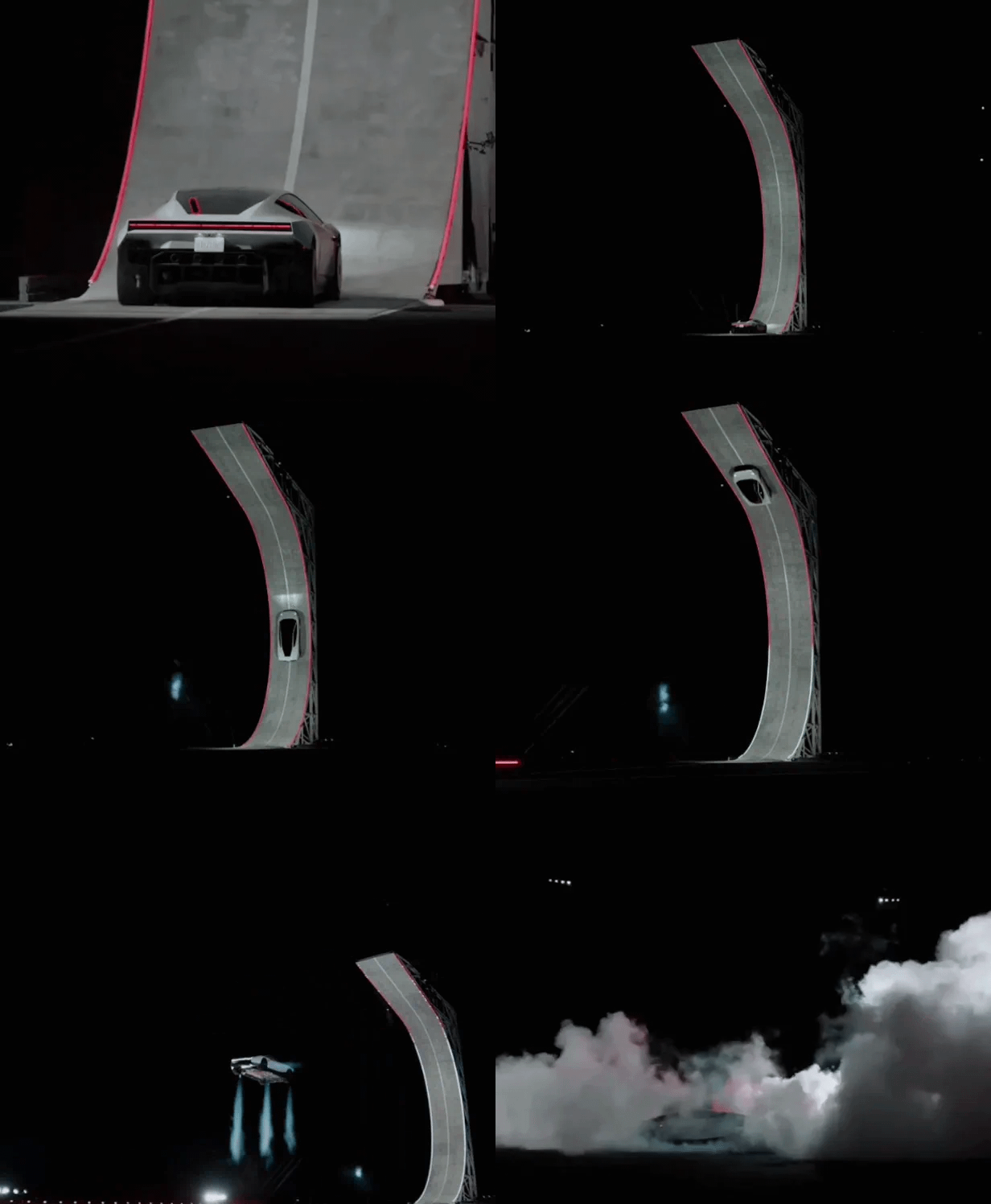
Now consider Tesla’s new Roadster, specifically the rocket variant, which combines cold-gas thrusters and fan-based suction in an automotive frame. Watch the full reveal (both the ramp and kickflip demonstrations), and reconcile it with the constraints above. From a pure technical perspective, it is one of the coolest expressions of engineering in the best possible sense. Set all practicality aside, and see if the thing can even exist.
It’s worth noting that the demo’d variant is a specific, and specifically impractical configuration (a single-seater with a second 400L COPV, for a total of 600L of nitrogen at 10 kpsi), and its eventual share of Tesla’s revenue likely won’t be meaningful. The better way to understand the development ethos, then, is not through practicality but as an exercise in engineering. A few notes on the two core technologies behind Thursday’s launch.
Fan-Based Suction
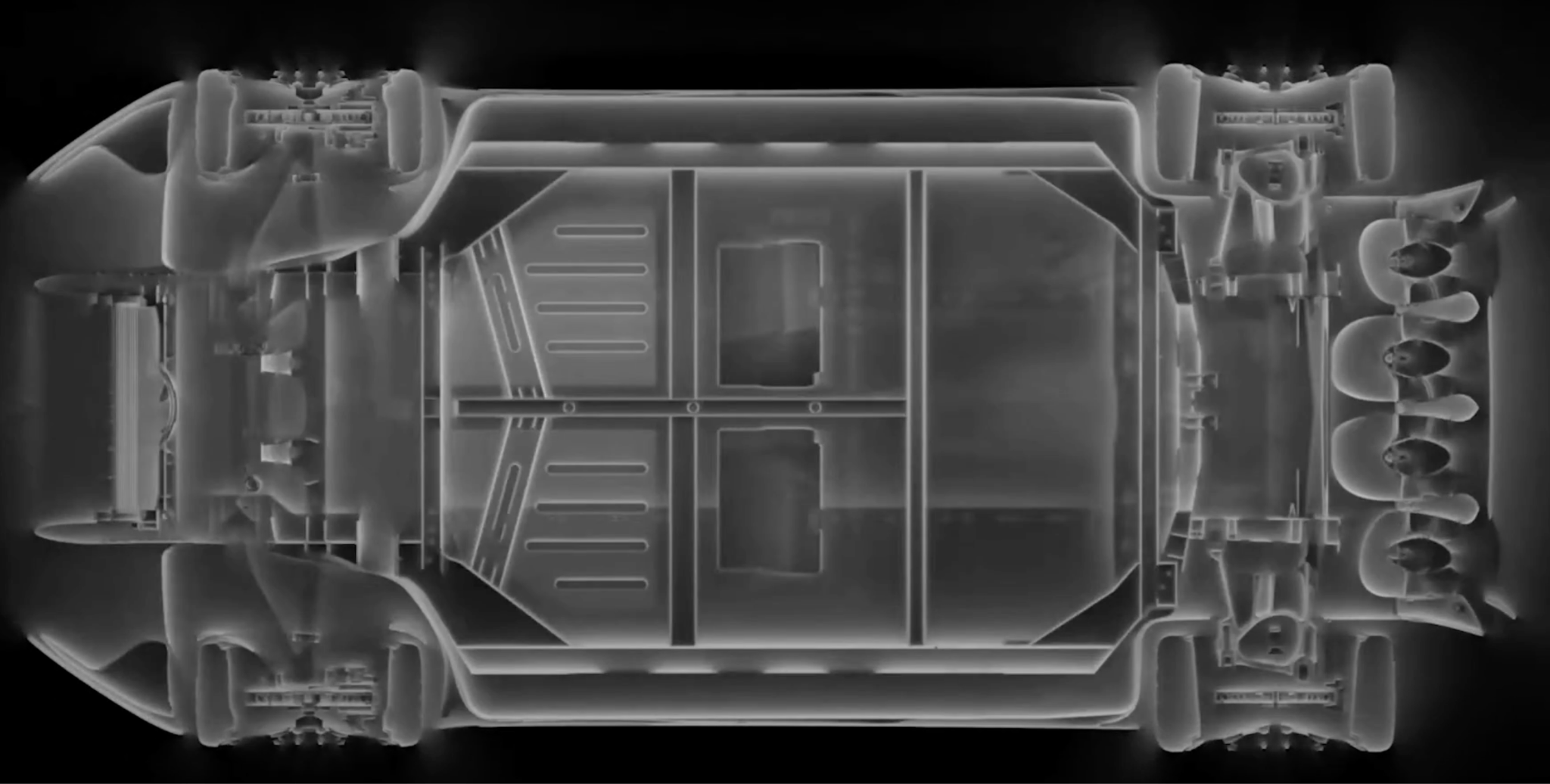
To achieve the upside-down ramp demo, the Roadster is held to the surface by four underbody fans and a set of deployable skirts, which form what Tesla calls the “sucker system.” As Lars Moravy, Tesla’s VP of vehicle engineering, puts it, the best road tires top out a bit over 1 G, so going further means either inventing better tire compounds or pulling the car down with air.
Fan-driven suction isn’t a new idea - it has precedent dating to the Chaparral 2J and the Brabham BT46B, and more recently McMurtry’s Spéirling, which also drove upside down. McMurtry’s patent (GB2591050) covers the core mechanism: a skirt sealed against the ground, a dedicated fan to evacuate it, active control of skirt height, and debris filtration. For scale, McMurtry’s twin fans produce 2,000 kg of downforce on a car that weighs ~1,000 kg. To hold at the ramp inverted, the Roadster’s fans have to exceed its own ~1,700 kg.
Tesla’s patent (US 12377920) claims a more practical setup that switches between two modes: fully sealed for launches and low-speed corners, and a partially sealed mode for higher speeds and rougher surfaces.
Composite Overwrapped Pressure Vessels
Now, how do you make a car both fly and achieve 0–60 in under a second? The answer is to integrate technology traditionally reserved for rockets into an automotive frame. Both demos employ cold-gas thrusters, using nitrogen stored in composite overwrapped pressure vessels (COPVs for short, made with a thin liner and a composite wrapping that reduces the need for metal walls). The Thrust model uses a single 200L COPV, and the Rocket variant’s “flight system” adds a second 400L vessel and six more thrusters: one at each corner and two at the front for yaw.
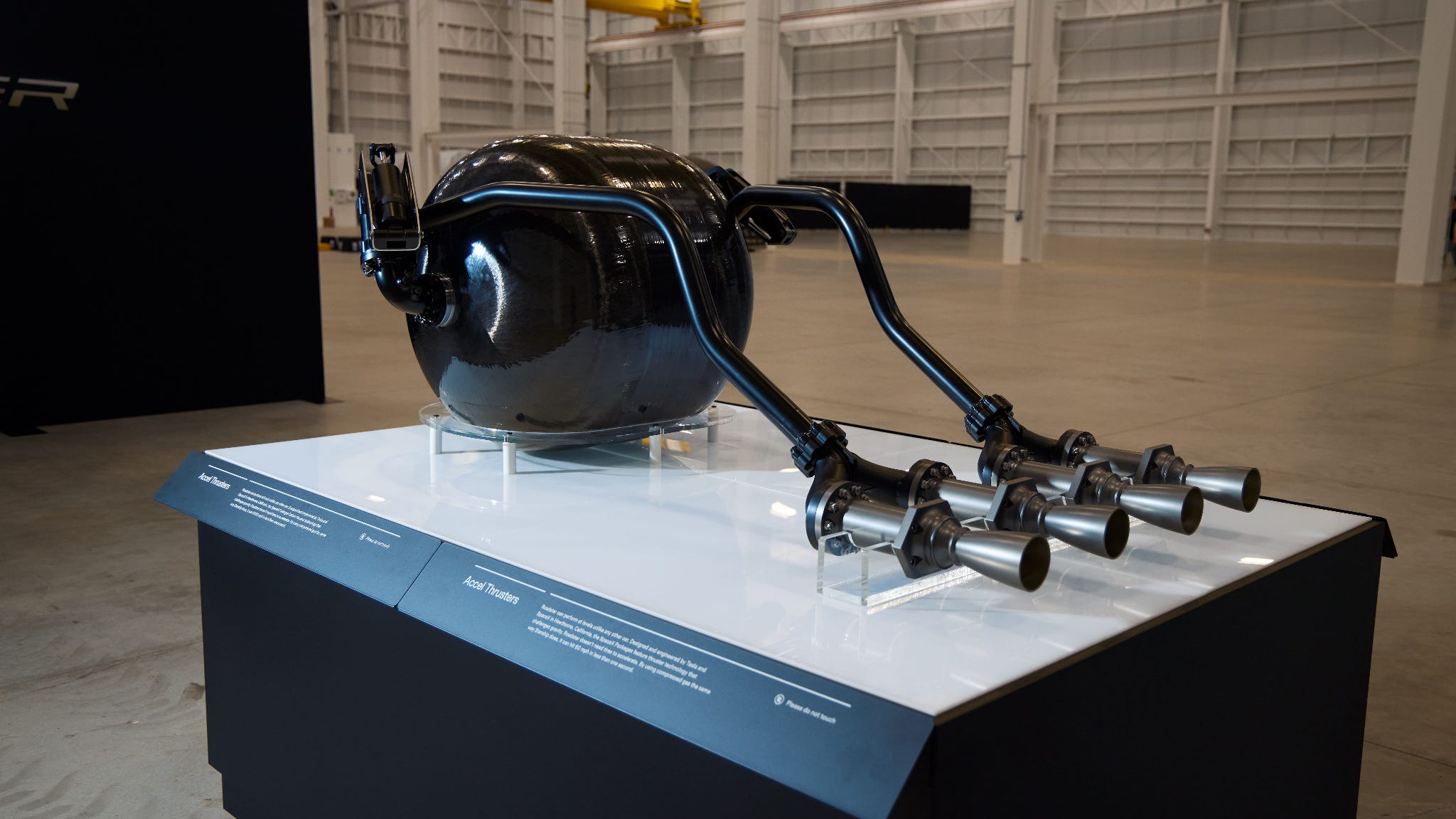
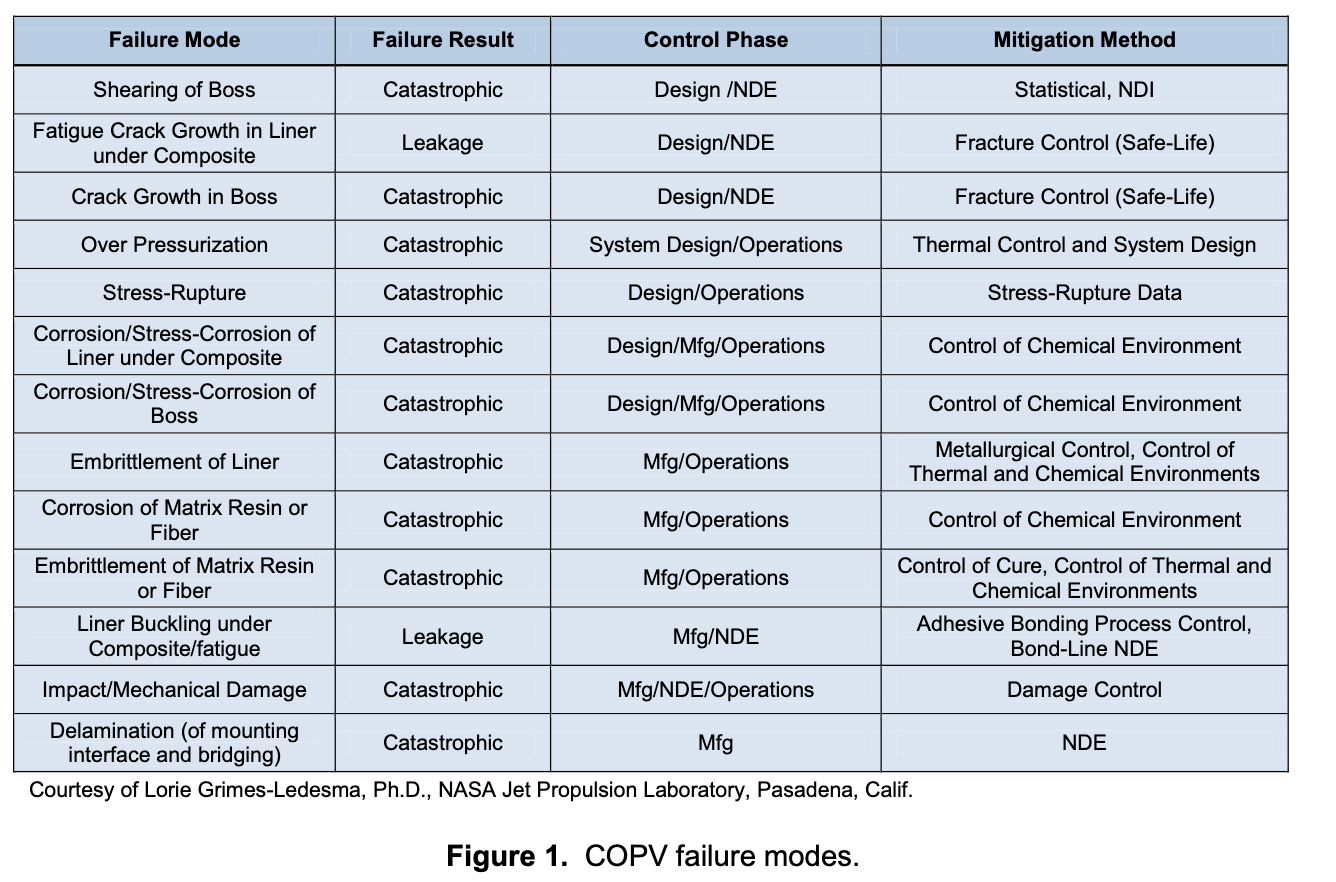
Again, this isn’t entirely foreign; the Toyota Mirai, a hydrogen fuel-cell sedan, has carried carbon-fiber-wrapped tanks at roughly equivalent pressures (~10,000 psi) since 2014. Similar vessels, but the Mirai drew its fuel over an entire trip, while the Roadster empties its nitrogen in seconds, at flow rates orders of magnitude higher. NASA has a great primer on COPVs across manufacturing, design, and typical failure modes.
More down the rabbit hole, including glimpses of early tests and prototype explosions.
More From Around the Web
If you’re equally fascinated by the Roadster announcement and didn’t bookmark NASA’s Composite Overwrapped Pressure Vessels, A Primer, consider scrolling back up.
How to Train Your Robot - understanding where robot training data comes from and the tradeoffs between different collection methods.
The engineering behind articulated buses
Cold War shenanigans led to the development of an androgynous docking system.
A reader submission from Jeff: Springly, a free spring selector tool.
Upcoming workshops on our radar:
Does a part really need to be custom, or can it be OTS? Understand the framework for making the call. (10/26)
3D print, machine, or mold your next medical device prototype? Register here. (11/3)
Presented by Xometry: What Medical Teams Need to Know
How early should medical device teams start thinking about production? Often, before the first engineering prototype is made. Material selection, manufacturing methods, and testing requirements can all influence the final design.
It’s a challenge Xometry engineers help medical device teams navigate. For medical components, that often means moving to production-grade resins and low-volume injection molding earlier in development. It also means designing for injection molding from the start, accounting for draft angles, uniform wall thickness, and part geometry that could make cleaning difficult.
See how Xometry’s manufacturing experts approach medical prototyping, including when to transition between processes, which test results can carry forward, and what to consider before investing in tooling.

Manufacturing & Startup News
Austin Sensing Company emerged from stealth with $15M in total funding to develop drone-detection systems combining RF, radar, and acoustic sensors.
Balerion Space Ventures raised $200M for its second fund to invest in space, defense, and related deep tech companies.
Origin emerged from stealth with $20M in total funding to deploy robots for interior construction, starting with wall finishing.
Ultra raised a $50M Series A led by Framework Ventures to expand its fleet of warehouse robots, which pack orders and are leased to customers monthly.
Tools From Our Partners
Xometry - Instant quoting on custom parts, from R&D prototypes to high-volume production runs.
Aris Machina Protos – Design & validate anything, with the AI-native workspace for industrial science and hardware R&D.
SolidWorks for Startups – Full access to SolidWorks’ product development tools, free for early-stage startups.
Zoo – AI-native CAD with a modern geometry engine, readable code, and editable feature trees for precise, editable models.
Trace.Space - The AI harness for hardware R&D.
Access Every Link We’ve Ever Shared 🎞️
Refer three friends to Hardware FYI and unlock our full archive.
Missed an issue? Hunting for that one link? Every tool, guide, and article we’ve ever shared is in here.
P.S. If you find something interesting—an article, tool, funding round, project, really anything—send it our way!
P.P.S. 20,000+ engineers, founders, and operators read this newsletter. If you want to reach them, get in touch.